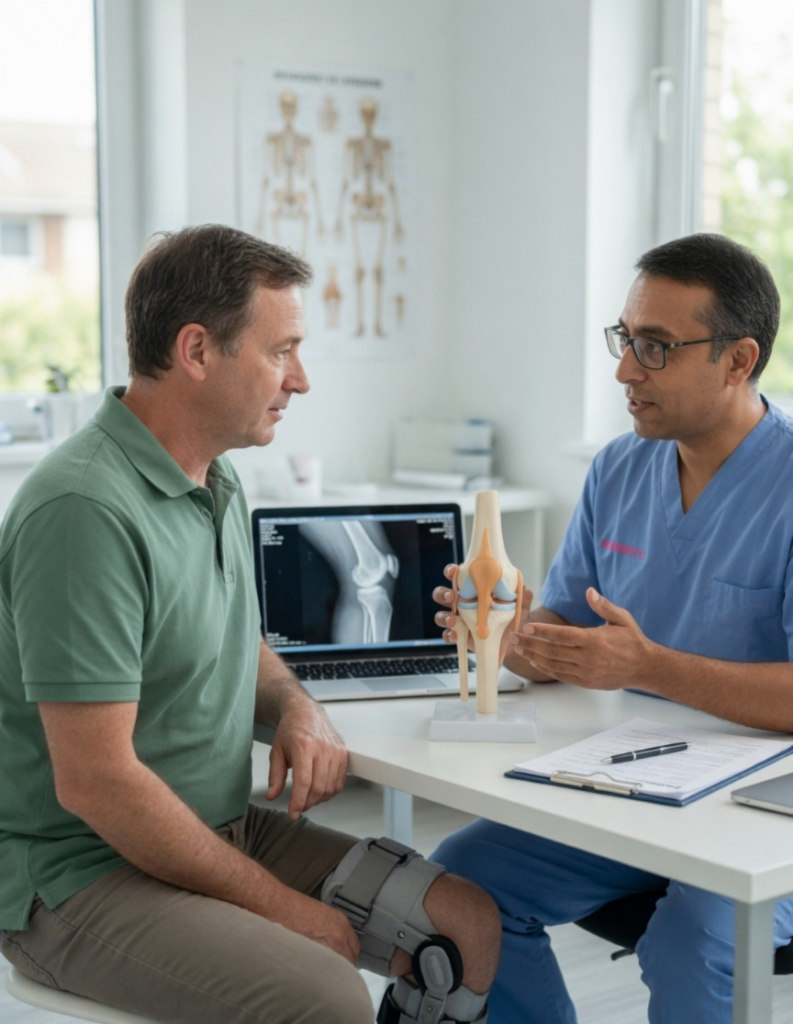
A knee problem that won’t settle with rest, painkillers or a few weeks of physiotherapy usually needs a closer look — not a long, open operation. Arthroscopic knee surgery is that closer look. Through two cuts of around 5 to 10 millimetres, a pencil-thin camera goes into the joint and the surgeon watches the cartilage, ligaments and meniscus on a monitor while repairing the damage with instruments passed through the same openings. At Bone & Joint Clinic in Sector 31, Noida, Dr Sumit Badhwar has been performing arthroscopic procedures for more than 15 years, and most patients walk out the same day.
If you’ve searched for Arthroscopic Knee Surgery in Noida and want a straight answer about what it involves, who it’s for and what recovery actually looks like, the rest of this page covers it.
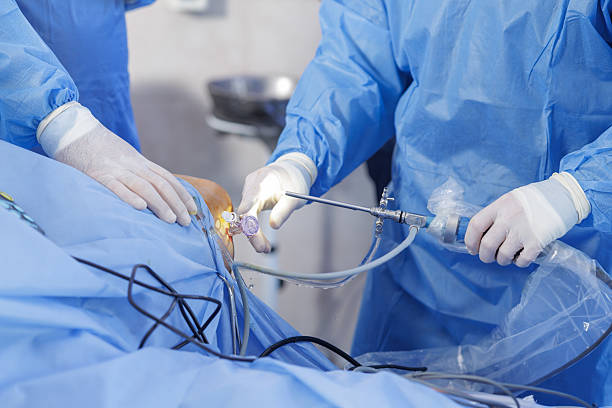
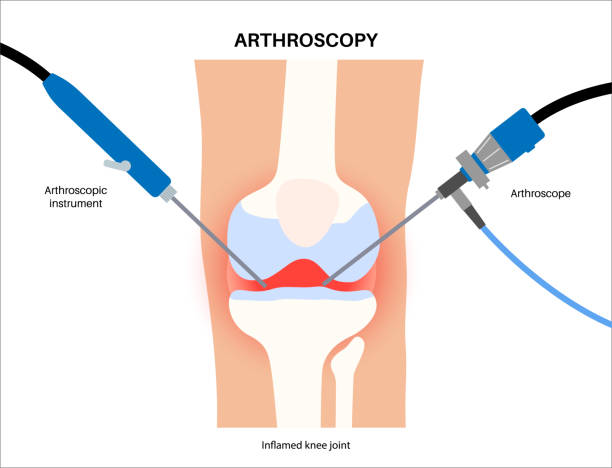
Arthroscopy is keyhole surgery for joints. For the knee, two small incisions are made on either side of the kneecap. One holds the arthroscope — a thin tube carrying a camera and a light. The other holds the working instrument: a probe, a shaver, scissors or a suture passer, depending on what needs doing. Sterile saline fluid runs through the joint to keep the view clear and the tissues protected.
Compared to a traditional open knee surgery in Noida, the difference is mostly about damage control. Less tissue is cut. Less blood is lost. The body has less to heal. That is the whole point: go in, fix what’s wrong, get out. This is the same family of techniques used in our wider Arthroscopic Surgery in Noida practice, applied specifically to the knee.
Arthroscopy is used in two ways: diagnostic (a direct look inside when MRI findings are unclear) and therapeutic (the actual repair). Both happen in the same sitting when needed.
Not sure if your knee pain needs surgery or just the right rehab plan? Book a consultation with Dr Sumit Badhwar, one of the Best Orthopedic Surgeon in Noida for joint and sports-related conditions.
Most arthroscopic knee work at the clinic falls into a handful of categories:
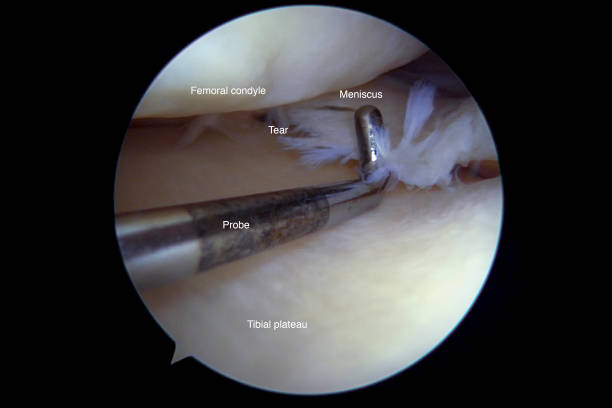
The meniscus is the C-shaped cartilage cushion inside the knee. A torn flap can be trimmed away, or in younger patients with a fresh tear, stitched back together (meniscal repair).
Reconstruction of a torn ligament using a graft, all done through keyhole openings. More on this under ligament injury treatment in Noida.
Loose fragments are removed and rough patches are smoothed. In selected younger patients, cartilage-restoration techniques like mosaicplasty are considered.
Realignment of how the kneecap sits and glides in its groove.
that hasn't cleared with medicines or aspiration.
when imaging is inconclusive and a direct look inside the joint is the cleanest way to a definite answer.
Sports injuries, road-traffic trauma and early-stage arthritis in younger patients all show up regularly. If your concern is sports-related, the sports injury doctor in Noida page covers that pathway in more detail. If the knee is already badly arthritic and the cartilage is gone, arthroscopy is usually not the right answer, and a knee replacement discussion makes more sense.
Day of surgery is usually shorter than people expect. Admission is in the morning, the procedure itself runs 30 to 90 minutes depending on what’s being done, and most patients are discharged the same evening or the next morning.
Step by step:
Usually spinal or regional. General anaesthesia is used in selected cases.
of about 5 to 10 mm on either side of the patella.
The team watches the inside of the joint on a high-definition monitor.
the joint to give a clear field of view and flush debris.
through the second incision — trimming a meniscus, drilling tunnels for an ACL graft, removing loose bodies, releasing a tight band, whatever the case calls for.
Each incision is closed with one or two stitches.
No heavy plaster. A knee brace is used when the ligament repair requires it.
You’ll be moved to recovery, given pain relief, and observed for a few hours before going home with a walking aid and a written rehab plan.
Have an MRI report and don’t know what to do next? Send it across when you book your appointment. Dr Badhwar reviews imaging before the consultation so the visit isn’t spent on basics — you walk in already on the same page.
The advantages are practical, not theoretical:
It isn’t a free pass. Arthroscopy is still surgery, and the result depends as much on what happens in physiotherapy afterwards as on the operation itself. A great surgical outcome with no rehab is still a half-result.
A few things actually matter when you’re picking a surgeon for knee surgery in Noida, and most of them aren’t on a billboard:
Dr Sumit Badhwar, regarded as one of the Best Orthopaedic Doctor in Noida, has been performing arthroscopic work across meniscus, ACL, PCL, cartilage and synovial conditions for over 15 years.
Diagnosis, imaging review, surgery, physiotherapy and follow-up all happen at Bone & Joint Clinic, Sector 31, Noida. You aren't handed off between three facilities and four receptionists.
Not every painful knee needs an arthroscope. When conservative orthopedic pain management is the right first step, that's what is recommended.
Training at Queens Medical Centre, Nottingham, UK, which is useful for ACL and meniscus work in active and competitive patients.
with physiotherapy started early — usually within 24 to 48 hours.
For broader joint or sports-related work, see Arthroscopy Surgeon in Noida or the sports injury treatment page.
Most arthroscopic knee procedures take 30 to 90 minutes inside the operating room. A simple meniscectomy sits at the shorter end. An ACL reconstruction with graft harvesting takes longer. Add anaesthesia prep, post-op observation and discharge paperwork, and your day at the hospital usually runs 5 to 7 hours.
It depends on what was done. A meniscus trimming: light desk work in 5 to 7 days and normal daily activity in 2 to 3 weeks. ACL reconstruction: crutches for 2 to 4 weeks, jogging at around 3 months and full sport at 9 to 12 months. Cartilage procedures sit somewhere in between. Honestly, physiotherapy progress matters more than the calendar — two patients on identical timelines can end up months apart based on how seriously they take rehab.
Broadly yes, but the planning is different at each end of the age range. Children with ligament or meniscus injuries need techniques that respect open growth plates. Older patients are assessed for fitness for anaesthesia and any underlying conditions like diabetes, hypertension or heart disease. Age by itself is rarely the deciding factor — overall health and the nature of the knee problem are.
Yes. Physiotherapy is part of the result, not an add-on. Range-of-motion exercises start within 24 to 48 hours. Strengthening builds up over the following weeks. The single most common reason an otherwise good arthroscopic result disappoints a patient is skipped or rushed rehab.
For most procedures, yes. Recreational sport returns in 2 to 4 months for meniscus and cartilage work, and 9 to 12 months for ACL reconstruction. Contact sports take longer than running or cycling. Clearance is based on objective strength, balance and stability tests — not just how the knee feels on a good day.
Ready to get a clear answer on your knee? Visit the Contact page or book a clinic appointment at Bone & Joint Clinic, Sector 31, Noida. Phone consultations are available for patients outside the city.
WhatsApp us